by Jeff Gaites
photos François Portmann

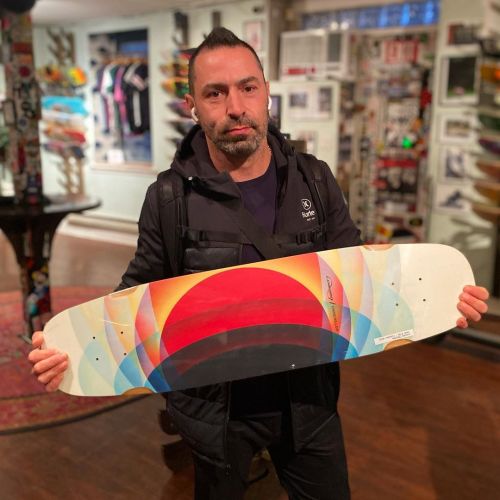
Mick Baldwin at Monkey Longboards recently teamed up with Chico, a major NYC graffiti artist, to paint custom works on skate decks. When we figured out that Chico was the same artist who had been blanketing downtown Manhattan for the last thirty years, we had to find out more about the man behind the spray-can.
If you’ve ever walked around the East Village and Lower East Side (LES) of Manhattan, then you’ve most likely seen the artwork of Antonio “Chico” Garcia. His prolific graffiti works date back to the 1980’s and include community-focused murals, memorials for victims of drug and gang wars, along with a whole host of signs for local businesses and clubs.

As a kid, Chico used to write on the walls of his family’s apartment and his mother would say, “What are you doing? This house is not our property…they’re gonna throw us out. Why don’t you find something to draw on besides our walls.” Chico liked to write and was born with a natural talent, so he took his message to the streets and started drawing on little boxes and other junk he could find. From there, Chico noticed that he was beginning to develop his own style and decided to get into graffiti art.

During the eighties, the subway trains served as a large canvas for graffiti (much to the dismay of city officials and police). Chico describes the early days, “I used to go to the lay-outs, or train yards, and spell my name real big “Chico”. It was just the trend, the experience, the fun, and running from the cops. I would put my name inside the trains with markers, and outside the trains with spray-cans. Actually, I used to “borrow” spray-cans from the hardware store down by 1st Avenue. They used to be $1.99/can, but I would go in there with a pea-coat, you know, one of those fire department coats that you put on. I put pockets on the sides, and me and my friend used to go in when they were busy…I would go in the back with the spray cans, and then walk out.”
“Borrowing” spray-cans didn’t raise any red-flags amidst the larger challenges facing a community already beset by violent crime and drugs. Chico talks about life at the time, “I was in an area where there were a lot of gangs…the Lower East Side was really bad back then. I was one of those kids that didn’t have anybody to look out for me. You know, people used to come out of nowhere, I mean all over the place. Even actors to buy drugs. Smack, sniffing glue, all the terrible crap in the past. So, you had actors in limousines and lines for drugs all over the place. We were just young kids and there were a lot of abandoned buildings, so we’d go into a building with our girlfriends to do the “wild thing” and just hang out, or run away from home. You know, it was like that, that kind of life in the Lower East Side back then. Then, it got a little more worse and as I grew, gangs took over the neighborhood.”

Like most graffiti artists, Chico was originally trying to get noticed. He and his buddy, Score, painted their first wall at John’s Pet Shop on Eldridge Street. Then, they painted the wall located on the northwest corner of Houston and Bowery. For those of you familiar with the graffiti art drama of NYC, this is the now infamous wall that has been painted and repainted by Keith Haring, Kenny Scharf, and several other well-known graffiti artists. Chico explains, “I was the first one who painted on that wall without permission. Me and my buddy painted a mural…a woman with a horse…it was a unicorn, and it was a big thing. And we did it for the graffiti. We wanted to get known out there, and we wanted to dress up the neighborhood with some art. It was the first graffiti art that ever touched that wall. Today, they closed the wall and now they’re having a thing out there where everyone wants to get famous.”

The abandoned buildings and difficult conditions of the neighborhood not only provided a venue for Chico to practice his art, but also shaped his message. He began painting large murals with taglines like; “Crack Kills”, “Stay in School”, or “Stay Away from Drugs”. Chico explains, “That’s how I started getting recognized and people started to hire me to do signs around the neighborhood and stuff like that. And that’s what I’ve been doing for years.”
During the most deadly periods of the drug and gang wars, Chico received many commissions to paint memorials for the victims. The memorial work paid well, so he continued to take on the commissions for a while. Unfortunately, Chico describes how the work began to weigh heavily on him and the neighborhood, “Word-of-mouth traveled and every time there was somebody killing somebody, Chico was there to pick up the pieces and do a mural. And that started the whole memorial thing that’s all over the streets in New York and, now, it’s world-wide. Now, I’ve stopped doing them because my whole neighborhood started looking scary. You know, you walk down the street…you have a face, you see another face there, another face there, and everything became depressing. It’s bad enough they’re selling drugs in the neighborhood, then you start seeing dead people. I started feeling that, so I stopped. I said to myself, hell no, I can’t be with this.”

These days, Chico is living in Tampa, but makes it back up to NYC whenever possible. To catch the more current-day photos for this story, we took a walking tour with him through his East Village gallery. Not a gallery located in the Village, but the East Village itself. We stopped by the hardware store on 1st Avenue where he used to “borrow” spray-cans as a kid. Now, Chico is life-long friends with the owner and his family. He purchases some spray-paint for a sign he was doing later that day at a local dentist’s office. As we walk around his neighborhood, Chico is greeted on almost every block with smiles, hello’s, hugs, and hand-shakes. You can see that he is deeply rooted in the community on a personal level, and the community is connected back to Chico through his artwork.